How to Draw a Circle in Canvas

Drawing shapes with canvas

  • « Previous
  • Next »

At present that nosotros have set up our canvas environment, we tin go into the details of how to depict on the canvas. Past the end of this article, you will have learned how to draw rectangles, triangles, lines, arcs and curves, providing familiarity with some of the bones shapes. Working with paths is essential when drawing objects onto the canvas and we volition see how that can be done.

The grid

Before nosotros can kickoff cartoon, nosotros need to talk about the canvas filigree or coordinate space. Our HTML skeleton from the previous page had a canvas chemical element 150 pixels wide and 150 pixels high.

Normally ane unit in the filigree corresponds to 1 pixel on the sail. The origin of this filigree is positioned in the top left corner at coordinate (0,0). All elements are placed relative to this origin. So the position of the height left corner of the blueish square becomes x pixels from the left and y pixels from the top, at coordinate (ten,y). Later in this tutorial nosotros'll see how we can interpret the origin to a different position, rotate the grid and fifty-fifty scale it, but for now nosotros'll stick to the default.

Cartoon rectangles

Unlike SVG, <canvas> only supports two archaic shapes: rectangles and paths (lists of points continued by lines). All other shapes must be created past combining one or more paths. Luckily, nosotros accept an assortment of path drawing functions which brand information technology possible to etch very complex shapes.

First let's look at the rectangle. There are three functions that draw rectangles on the canvas:

fillRect(ten, y, width, height)

Draws a filled rectangle.

strokeRect(10, y, width, height)

Draws a rectangular outline.

clearRect(ten, y, width, tiptop)

Clears the specified rectangular area, making it fully transparent.

Each of these three functions takes the same parameters. x and y specify the position on the canvas (relative to the origin) of the top-left corner of the rectangle. width and acme provide the rectangle's size.

Beneath is the depict() role from the previous page, only now it is making apply of these iii functions.

Rectangular shape instance

                                  function                  describe                  (                  )                  {                  var                  sail                  =                  certificate.                  getElementById                  (                  'canvas'                  )                  ;                  if                  (canvas.getContext)                  {                  var                  ctx                  =                  canvas.                  getContext                  (                  '2d'                  )                  ;                  ctx.                  fillRect                  (                  25                  ,                  25                  ,                  100                  ,                  100                  )                  ;                  ctx.                  clearRect                  (                  45                  ,                  45                  ,                  threescore                  ,                  lx                  )                  ;                  ctx.                  strokeRect                  (                  50                  ,                  50                  ,                  50                  ,                  50                  )                  ;                  }                  }                              

This example's output is shown beneath.

The fillRect() function draws a large black foursquare 100 pixels on each side. The clearRect() part then erases a 60x60 pixel foursquare from the center, and so strokeRect() is called to create a rectangular outline 50x50 pixels inside the cleared square.

In upcoming pages nosotros'll meet ii alternative methods for clearRect(), and we'll also see how to modify the color and stroke mode of the rendered shapes.

Different the path functions we'll see in the side by side section, all 3 rectangle functions draw immediately to the canvas.

Drawing paths

Now let's expect at paths. A path is a list of points, connected by segments of lines that can exist of dissimilar shapes, curved or not, of unlike width and of different colour. A path, or fifty-fifty a subpath, can be closed. To make shapes using paths, we take some extra steps:

  1. First, you create the path.
  2. Then you use drawing commands to depict into the path.
  3. Once the path has been created, y'all can stroke or fill the path to render it.

Hither are the functions used to perform these steps:

beginPath()

Creates a new path. Once created, futurity cartoon commands are directed into the path and used to build the path up.

Path methods

Methods to set dissimilar paths for objects.

closePath()

Adds a straight line to the path, going to the start of the current sub-path.

stroke()

Draws the shape by stroking its outline.

fill()

Draws a solid shape by filling the path's content area.

The kickoff step to create a path is to telephone call the beginPath(). Internally, paths are stored every bit a listing of sub-paths (lines, arcs, etc) which together form a shape. Every time this method is called, the list is reset and we can kickoff drawing new shapes.

Note: When the current path is empty, such as immediately after calling beginPath(), or on a newly created sail, the first path construction control is ever treated as a moveTo(), regardless of what it actually is. For that reason, yous will nigh always want to specifically set up your starting position afterward resetting a path.

The 2nd step is calling the methods that actually specify the paths to be drawn. We'll see these shortly.

The third, and an optional footstep, is to telephone call closePath(). This method tries to close the shape by drawing a straight line from the current point to the get-go. If the shape has already been closed or at that place'due south only one point in the list, this function does goose egg.

Note: When yous phone call fill(), any open shapes are closed automatically, then you don't have to call closePath(). This is not the case when you phone call stroke().

Cartoon a triangle

For instance, the code for cartoon a triangle would expect something like this:

                                  function                  draw                  (                  )                  {                  var                  canvas                  =                  document.                  getElementById                  (                  'canvas'                  )                  ;                  if                  (canvas.getContext)                  {                  var                  ctx                  =                  sail.                  getContext                  (                  '2d'                  )                  ;                  ctx.                  beginPath                  (                  )                  ;                  ctx.                  moveTo                  (                  75                  ,                  fifty                  )                  ;                  ctx.                  lineTo                  (                  100                  ,                  75                  )                  ;                  ctx.                  lineTo                  (                  100                  ,                  25                  )                  ;                  ctx.                  fill                  (                  )                  ;                  }                  }                              

The result looks similar this:

Moving the pen

One very useful office, which doesn't actually describe anything merely becomes part of the path list described above, is the moveTo() function. You can probably all-time think of this as lifting a pen or pencil from ane spot on a piece of newspaper and placing it on the next.

moveTo(x, y)

Moves the pen to the coordinates specified by ten and y.

When the canvas is initialized or beginPath() is chosen, you typically will want to use the moveTo() function to place the starting point somewhere else. We could also use moveTo() to describe unconnected paths. Have a look at the smiley face below.

To try this for yourself, you tin can utilise the code snippet beneath. Just paste it into the describe() function we saw earlier.

                                  office                  draw                  (                  )                  {                  var                  canvas                  =                  certificate.                  getElementById                  (                  'canvas'                  )                  ;                  if                  (canvas.getContext)                  {                  var                  ctx                  =                  canvas.                  getContext                  (                  '2d'                  )                  ;                  ctx.                  beginPath                  (                  )                  ;                  ctx.                  arc                  (                  75                  ,                  75                  ,                  fifty                  ,                  0                  ,                  Math.                  PI                  *                  2                  ,                  true                  )                  ;                  // Outer circle                  ctx.                  moveTo                  (                  110                  ,                  75                  )                  ;                  ctx.                  arc                  (                  75                  ,                  75                  ,                  35                  ,                  0                  ,                  Math.                  PI                  ,                  false                  )                  ;                  // Mouth (clockwise)                  ctx.                  moveTo                  (                  65                  ,                  65                  )                  ;                  ctx.                  arc                  (                  60                  ,                  65                  ,                  v                  ,                  0                  ,                  Math.                  PI                  *                  2                  ,                  true                  )                  ;                  // Left eye                  ctx.                  moveTo                  (                  95                  ,                  65                  )                  ;                  ctx.                  arc                  (                  90                  ,                  65                  ,                  5                  ,                  0                  ,                  Math.                  PI                  *                  2                  ,                  truthful                  )                  ;                  // Right center                  ctx.                  stroke                  (                  )                  ;                  }                  }                              

The result looks like this:

If you'd like to encounter the connecting lines, you can remove the lines that phone call moveTo().

Annotation: To learn more almost the arc() function, encounter the Arcs department below.

Lines

For drawing direct lines, utilize the lineTo() method.

lineTo(x, y)

Draws a line from the current cartoon position to the position specified by x and y.

This method takes two arguments, x and y, which are the coordinates of the line'south cease point. The starting point is dependent on previously fatigued paths, where the end indicate of the previous path is the starting signal for the following, etc. The starting point can too be changed by using the moveTo() method.

The example below draws 2 triangles, one filled and one outlined.

                                  function                  draw                  (                  )                  {                  var                  canvas                  =                  certificate.                  getElementById                  (                  'sheet'                  )                  ;                  if                  (canvass.getContext)                  {                  var                  ctx                  =                  canvas.                  getContext                  (                  '2d'                  )                  ;                  // Filled triangle                  ctx.                  beginPath                  (                  )                  ;                  ctx.                  moveTo                  (                  25                  ,                  25                  )                  ;                  ctx.                  lineTo                  (                  105                  ,                  25                  )                  ;                  ctx.                  lineTo                  (                  25                  ,                  105                  )                  ;                  ctx.                  make full                  (                  )                  ;                  // Stroked triangle                  ctx.                  beginPath                  (                  )                  ;                  ctx.                  moveTo                  (                  125                  ,                  125                  )                  ;                  ctx.                  lineTo                  (                  125                  ,                  45                  )                  ;                  ctx.                  lineTo                  (                  45                  ,                  125                  )                  ;                  ctx.                  closePath                  (                  )                  ;                  ctx.                  stroke                  (                  )                  ;                  }                  }                              

This starts by calling beginPath() to start a new shape path. Nosotros then apply the moveTo() method to move the starting bespeak to the desired position. Below this, ii lines are drawn which make upward two sides of the triangle.

Yous'll observe the difference between the filled and stroked triangle. This is, every bit mentioned above, because shapes are automatically closed when a path is filled, but non when they are stroked. If nosotros left out the closePath() for the stroked triangle, simply ii lines would take been drawn, non a consummate triangle.

Arcs

To describe arcs or circles, we use the arc() or arcTo() methods.

arc(x, y, radius, startAngle, endAngle, counterclockwise)

Draws an arc which is centered at (x, y) position with radius r starting at startAngle and catastrophe at endAngle going in the given management indicated by counterclockwise (defaulting to clockwise).

arcTo(x1, y1, x2, y2, radius)

Draws an arc with the given control points and radius, connected to the previous point by a straight line.

Let'south have a more than detailed look at the arc method, which takes half dozen parameters: ten and y are the coordinates of the center of the circle on which the arc should be drawn. radius is self-explanatory. The startAngle and endAngle parameters ascertain the commencement and end points of the arc in radians, forth the curve of the circle. These are measured from the x centrality. The counterclockwise parameter is a Boolean value which, when true, draws the arc counterclockwise; otherwise, the arc is drawn clockwise.

Note: Angles in the arc function are measured in radians, not degrees. To convert degrees to radians y'all tin can utilize the following JavaScript expression: radians = (Math.PI/180)*degrees.

The following example is a little more complex than the ones we've seen above. It draws 12 different arcs all with different angles and fills.

The two for loops are for looping through the rows and columns of arcs. For each arc, we start a new path by calling beginPath(). In the code, each of the parameters for the arc is in a variable for clarity, but y'all wouldn't necessarily practice that in real life.

The x and y coordinates should exist clear plenty. radius and startAngle are stock-still. The endAngle starts at 180 degrees (one-half a circle) in the starting time column and is increased by steps of 90 degrees, culminating in a complete circle in the terminal cavalcade.

The statement for the clockwise parameter results in the showtime and third row being fatigued as clockwise arcs and the second and fourth row as counterclockwise arcs. Finally, the if statement makes the top half stroked arcs and the bottom half filled arcs.

Note: This example requires a slightly larger canvas than the others on this page: 150 x 200 pixels.

                                  function                  draw                  (                  )                  {                  var                  sail                  =                  document.                  getElementById                  (                  'canvas'                  )                  ;                  if                  (canvas.getContext)                  {                  var                  ctx                  =                  sheet.                  getContext                  (                  '2d'                  )                  ;                  for                  (                  var                  i                  =                  0                  ;                  i                  <                  4                  ;                  i++                  )                  {                  for                  (                  var                  j                  =                  0                  ;                  j                  <                  3                  ;                  j++                  )                  {                  ctx.                  beginPath                  (                  )                  ;                  var                  x                  =                  25                  +                  j                  *                  fifty                  ;                  // x coordinate                  var                  y                  =                  25                  +                  i                  *                  l                  ;                  // y coordinate                  var                  radius                  =                  xx                  ;                  // Arc radius                  var                  startAngle                  =                  0                  ;                  // Starting bespeak on circle                  var                  endAngle                  =                  Math.                  PI                  +                  (Math.                  PI                  *                  j)                  /                  2                  ;                  // End indicate on circumvolve                  var                  counterclockwise                  =                  i                  %                  2                  !==                  0                  ;                  // clockwise or counterclockwise                  ctx.                  arc                  (x,                  y,                  radius,                  startAngle,                  endAngle,                  counterclockwise)                  ;                  if                  (i                  >                  1                  )                  {                  ctx.                  fill                  (                  )                  ;                  }                  else                  {                  ctx.                  stroke                  (                  )                  ;                  }                  }                  }                  }                  }                              

Bezier and quadratic curves

The next type of paths bachelor are Bézier curves, available in both cubic and quadratic varieties. These are generally used to depict complex organic shapes.

quadraticCurveTo(cp1x, cp1y, 10, y)

Draws a quadratic Bézier curve from the current pen position to the finish betoken specified by ten and y, using the control point specified past cp1x and cp1y.

bezierCurveTo(cp1x, cp1y, cp2x, cp2y, ten, y)

Draws a cubic Bézier bend from the electric current pen position to the end point specified past x and y, using the control points specified by (cp1x, cp1y) and (cp2x, cp2y).

The difference between these is that a quadratic Bézier bend has a kickoff and an end indicate (blue dots) and just one control point (indicated by the red dot) while a cubic Bézier curve uses two control points.
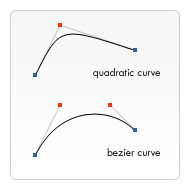
The x and y parameters in both of these methods are the coordinates of the end point. cp1x and cp1y are the coordinates of the starting time control signal, and cp2x and cp2y are the coordinates of the 2d command betoken.

Using quadratic and cubic Bézier curves can exist quite challenging, because unlike vector drawing software similar Adobe Illustrator, we don't take direct visual feedback equally to what we're doing. This makes it pretty hard to draw complex shapes. In the following example, we'll be drawing some unproblematic organic shapes, merely if y'all have the time and, most of all, the patience, much more circuitous shapes tin exist created.

In that location'south nothing very difficult in these examples. In both cases we encounter a succession of curves being drawn which finally result in a complete shape.

Quadratic Bezier curves

This case uses multiple quadratic Bézier curves to render a speech airship.

                                  function                  draw                  (                  )                  {                  var                  sail                  =                  document.                  getElementById                  (                  'sheet'                  )                  ;                  if                  (sail.getContext)                  {                  var                  ctx                  =                  canvas.                  getContext                  (                  '2d'                  )                  ;                  // Quadratic curves example                  ctx.                  beginPath                  (                  )                  ;                  ctx.                  moveTo                  (                  75                  ,                  25                  )                  ;                  ctx.                  quadraticCurveTo                  (                  25                  ,                  25                  ,                  25                  ,                  62.v                  )                  ;                  ctx.                  quadraticCurveTo                  (                  25                  ,                  100                  ,                  l                  ,                  100                  )                  ;                  ctx.                  quadraticCurveTo                  (                  fifty                  ,                  120                  ,                  30                  ,                  125                  )                  ;                  ctx.                  quadraticCurveTo                  (                  threescore                  ,                  120                  ,                  65                  ,                  100                  )                  ;                  ctx.                  quadraticCurveTo                  (                  125                  ,                  100                  ,                  125                  ,                  62.5                  )                  ;                  ctx.                  quadraticCurveTo                  (                  125                  ,                  25                  ,                  75                  ,                  25                  )                  ;                  ctx.                  stroke                  (                  )                  ;                  }                  }                              

Cubic Bezier curves

This example draws a center using cubic Bézier curves.

                                  part                  depict                  (                  )                  {                  var                  sheet                  =                  certificate.                  getElementById                  (                  'sheet'                  )                  ;                  if                  (canvass.getContext)                  {                  var                  ctx                  =                  sail.                  getContext                  (                  '2d'                  )                  ;                  // Cubic curves example                  ctx.                  beginPath                  (                  )                  ;                  ctx.                  moveTo                  (                  75                  ,                  40                  )                  ;                  ctx.                  bezierCurveTo                  (                  75                  ,                  37                  ,                  lxx                  ,                  25                  ,                  l                  ,                  25                  )                  ;                  ctx.                  bezierCurveTo                  (                  20                  ,                  25                  ,                  twenty                  ,                  62.5                  ,                  20                  ,                  62.5                  )                  ;                  ctx.                  bezierCurveTo                  (                  20                  ,                  80                  ,                  40                  ,                  102                  ,                  75                  ,                  120                  )                  ;                  ctx.                  bezierCurveTo                  (                  110                  ,                  102                  ,                  130                  ,                  80                  ,                  130                  ,                  62.v                  )                  ;                  ctx.                  bezierCurveTo                  (                  130                  ,                  62.5                  ,                  130                  ,                  25                  ,                  100                  ,                  25                  )                  ;                  ctx.                  bezierCurveTo                  (                  85                  ,                  25                  ,                  75                  ,                  37                  ,                  75                  ,                  40                  )                  ;                  ctx.                  fill                  (                  )                  ;                  }                  }                              

Rectangles

In add-on to the three methods we saw in Cartoon rectangles, which draw rectangular shapes straight to the canvas, there's also the rect() method, which adds a rectangular path to a currently open path.

rect(x, y, width, height)

Draws a rectangle whose top-left corner is specified by (10, y) with the specified width and height.

Before this method is executed, the moveTo() method is automatically called with the parameters (ten,y). In other words, the current pen position is automatically reset to the default coordinates.

Making combinations

And then far, each example on this page has used simply 1 type of path function per shape. Nonetheless, there'south no limitation to the number or types of paths you can use to create a shape. So in this final case, let'south combine all of the path functions to make a ready of very famous game characters.

                                  function                  draw                  (                  )                  {                  var                  canvas                  =                  document.                  getElementById                  (                  'sheet'                  )                  ;                  if                  (canvas.getContext)                  {                  var                  ctx                  =                  canvas.                  getContext                  (                  '2d'                  )                  ;                  roundedRect                  (ctx,                  12                  ,                  12                  ,                  150                  ,                  150                  ,                  15                  )                  ;                  roundedRect                  (ctx,                  xix                  ,                  19                  ,                  150                  ,                  150                  ,                  9                  )                  ;                  roundedRect                  (ctx,                  53                  ,                  53                  ,                  49                  ,                  33                  ,                  10                  )                  ;                  roundedRect                  (ctx,                  53                  ,                  119                  ,                  49                  ,                  16                  ,                  6                  )                  ;                  roundedRect                  (ctx,                  135                  ,                  53                  ,                  49                  ,                  33                  ,                  10                  )                  ;                  roundedRect                  (ctx,                  135                  ,                  119                  ,                  25                  ,                  49                  ,                  10                  )                  ;                  ctx.                  beginPath                  (                  )                  ;                  ctx.                  arc                  (                  37                  ,                  37                  ,                  13                  ,                  Math.                  PI                  /                  vii                  ,                  -Math.                  PI                  /                  7                  ,                  fake                  )                  ;                  ctx.                  lineTo                  (                  31                  ,                  37                  )                  ;                  ctx.                  fill up                  (                  )                  ;                  for                  (                  var                  i                  =                  0                  ;                  i                  <                  8                  ;                  i++                  )                  {                  ctx.                  fillRect                  (                  51                  +                  i                  *                  16                  ,                  35                  ,                  4                  ,                  4                  )                  ;                  }                  for                  (i                  =                  0                  ;                  i                  <                  6                  ;                  i++                  )                  {                  ctx.                  fillRect                  (                  115                  ,                  51                  +                  i                  *                  16                  ,                  iv                  ,                  four                  )                  ;                  }                  for                  (i                  =                  0                  ;                  i                  <                  8                  ;                  i++                  )                  {                  ctx.                  fillRect                  (                  51                  +                  i                  *                  16                  ,                  99                  ,                  4                  ,                  4                  )                  ;                  }                  ctx.                  beginPath                  (                  )                  ;                  ctx.                  moveTo                  (                  83                  ,                  116                  )                  ;                  ctx.                  lineTo                  (                  83                  ,                  102                  )                  ;                  ctx.                  bezierCurveTo                  (                  83                  ,                  94                  ,                  89                  ,                  88                  ,                  97                  ,                  88                  )                  ;                  ctx.                  bezierCurveTo                  (                  105                  ,                  88                  ,                  111                  ,                  94                  ,                  111                  ,                  102                  )                  ;                  ctx.                  lineTo                  (                  111                  ,                  116                  )                  ;                  ctx.                  lineTo                  (                  106.333                  ,                  111.333                  )                  ;                  ctx.                  lineTo                  (                  101.666                  ,                  116                  )                  ;                  ctx.                  lineTo                  (                  97                  ,                  111.333                  )                  ;                  ctx.                  lineTo                  (                  92.333                  ,                  116                  )                  ;                  ctx.                  lineTo                  (                  87.666                  ,                  111.333                  )                  ;                  ctx.                  lineTo                  (                  83                  ,                  116                  )                  ;                  ctx.                  make full                  (                  )                  ;                  ctx.fillStyle                  =                  'white'                  ;                  ctx.                  beginPath                  (                  )                  ;                  ctx.                  moveTo                  (                  91                  ,                  96                  )                  ;                  ctx.                  bezierCurveTo                  (                  88                  ,                  96                  ,                  87                  ,                  99                  ,                  87                  ,                  101                  )                  ;                  ctx.                  bezierCurveTo                  (                  87                  ,                  103                  ,                  88                  ,                  106                  ,                  91                  ,                  106                  )                  ;                  ctx.                  bezierCurveTo                  (                  94                  ,                  106                  ,                  95                  ,                  103                  ,                  95                  ,                  101                  )                  ;                  ctx.                  bezierCurveTo                  (                  95                  ,                  99                  ,                  94                  ,                  96                  ,                  91                  ,                  96                  )                  ;                  ctx.                  moveTo                  (                  103                  ,                  96                  )                  ;                  ctx.                  bezierCurveTo                  (                  100                  ,                  96                  ,                  99                  ,                  99                  ,                  99                  ,                  101                  )                  ;                  ctx.                  bezierCurveTo                  (                  99                  ,                  103                  ,                  100                  ,                  106                  ,                  103                  ,                  106                  )                  ;                  ctx.                  bezierCurveTo                  (                  106                  ,                  106                  ,                  107                  ,                  103                  ,                  107                  ,                  101                  )                  ;                  ctx.                  bezierCurveTo                  (                  107                  ,                  99                  ,                  106                  ,                  96                  ,                  103                  ,                  96                  )                  ;                  ctx.                  make full                  (                  )                  ;                  ctx.fillStyle                  =                  'black'                  ;                  ctx.                  beginPath                  (                  )                  ;                  ctx.                  arc                  (                  101                  ,                  102                  ,                  2                  ,                  0                  ,                  Math.                  PI                  *                  2                  ,                  true                  )                  ;                  ctx.                  fill                  (                  )                  ;                  ctx.                  beginPath                  (                  )                  ;                  ctx.                  arc                  (                  89                  ,                  102                  ,                  2                  ,                  0                  ,                  Math.                  PI                  *                  ii                  ,                  true                  )                  ;                  ctx.                  fill                  (                  )                  ;                  }                  }                  // A utility function to describe a rectangle with rounded corners.                  part                  roundedRect                  (                  ctx,                    x,                    y,                    width,                    acme,                    radius                  )                  {                  ctx.                  beginPath                  (                  )                  ;                  ctx.                  moveTo                  (x,                  y                  +                  radius)                  ;                  ctx.                  arcTo                  (x,                  y                  +                  top,                  10                  +                  radius,                  y                  +                  height,                  radius)                  ;                  ctx.                  arcTo                  (x                  +                  width,                  y                  +                  height,                  ten                  +                  width,                  y                  +                  pinnacle                  -                  radius,                  radius)                  ;                  ctx.                  arcTo                  (x                  +                  width,                  y,                  10                  +                  width                  -                  radius,                  y,                  radius)                  ;                  ctx.                  arcTo                  (x,                  y,                  x,                  y                  +                  radius,                  radius)                  ;                  ctx.                  stroke                  (                  )                  ;                  }                              

The resulting image looks similar this:

Nosotros won't go over this in detail, since it'due south actually surprisingly simple. The almost important things to note are the utilise of the fillStyle property on the drawing context, and the employ of a utility function (in this instance roundedRect()). Using utility functions for bits of drawing you do often tin be very helpful and reduce the amount of code you need, as well equally its complexity.

We'll take another look at fillStyle, in more than detail, later in this tutorial. Here, all nosotros're doing is using it to change the fill up color for paths from the default color of black to white, and then back again.

Path2D objects

As we have seen in the last instance, in that location can be a series of paths and drawing commands to draw objects onto your canvas. To simplify the code and to improve operation, the Path2D object, available in contempo versions of browsers, lets you cache or record these drawing commands. You are able to play back your paths quickly. Let's come across how we can construct a Path2D object:

Path2D()

The Path2D() constructor returns a newly instantiated Path2D object, optionally with another path every bit an argument (creates a re-create), or optionally with a string consisting of SVG path data.

                                  new                  Path2D                  (                  )                  ;                  // empty path object                  new                  Path2D                  (path)                  ;                  // re-create from another Path2D object                  new                  Path2D                  (d)                  ;                  // path from SVG path information                              

All path methods similar moveTo, rect, arc or quadraticCurveTo, etc., which nosotros got to know higher up, are bachelor on Path2D objects.

The Path2D API as well adds a way to combine paths using the addPath method. This tin be useful when you want to build objects from several components, for example.

Path2D.addPath(path [, transform])

Adds a path to the current path with an optional transformation matrix.

Path2D case

In this example, we are creating a rectangle and a circle. Both are stored as a Path2D object, so that they are available for later usage. With the new Path2D API, several methods got updated to optionally accept a Path2D object to use instead of the current path. Here, stroke and fill are used with a path argument to describe both objects onto the sail, for example.

                                  role                  draw                  (                  )                  {                  var                  canvas                  =                  document.                  getElementById                  (                  'sheet'                  )                  ;                  if                  (canvas.getContext)                  {                  var                  ctx                  =                  canvas.                  getContext                  (                  '2nd'                  )                  ;                  var                  rectangle                  =                  new                  Path2D                  (                  )                  ;                  rectangle.                  rect                  (                  x                  ,                  10                  ,                  50                  ,                  50                  )                  ;                  var                  circumvolve                  =                  new                  Path2D                  (                  )                  ;                  circle.                  arc                  (                  100                  ,                  35                  ,                  25                  ,                  0                  ,                  2                  *                  Math.                  PI                  )                  ;                  ctx.                  stroke                  (rectangle)                  ;                  ctx.                  fill                  (circumvolve)                  ;                  }                  }                              

Using SVG paths

Another powerful feature of the new canvass Path2D API is using SVG path data to initialize paths on your canvas. This might allow you to pass around path data and re-utilize them in both, SVG and sail.

The path volition motility to indicate (M10 x) and then motion horizontally eighty points to the right (h 80), then eighty points downward (v eighty), then 80 points to the left (h -80), and and so back to the start (z). You can see this example on the Path2D constructor folio.

                                  var                  p                  =                  new                  Path2D                  (                  'M10 10 h 80 five 80 h -fourscore Z'                  )                  ;                              
  • « Previous
  • Next »

rizzoounly1962.blogspot.com

Source: https://developer.mozilla.org/en-US/docs/Web/API/Canvas_API/Tutorial/Drawing_shapes

0 Response to "How to Draw a Circle in Canvas"

Publicar un comentario

Iklan Atas Artikel

Iklan Tengah Artikel 1

Iklan Tengah Artikel 2

Iklan Bawah Artikel